
SAN FRANCISCO (RNS) — In early 2025, when Paul Taylor left the Palo Alto church he’d pastored for 18 years to focus on nonprofit work, he didn’t know where it would lead. Certainly, Taylor didn’t anticipate that, in September, he would be invited to a wood-paneled venue in downtown San Francisco, where the founder of PayPal expounded on the Antichrist for four Mondays in a row.
The sold-out lecture series, delivered by tech billionaire Peter Thiel, was hosted by The ACTS 17 Collective, a Christian organization that has made headlines for its big-name speaker events. But September’s lectures, billed as “Peter Thiel on the Antichrist through the lenses of faith, science, and culture,” drew a new level of intrigue — and controversy. The first night, devil-costumed protesters clogged the sidewalk while ticket-holders filed into San Francisco’s Commonwealth Club.
Taylor, who attended the off-the-record talks with Denise Lee Yohn, his co-founder at the Bay Area Center for Faith, Work, and Tech, was most struck by the audience. What initially felt like a “tech networking event” quickly turned spiritual, he said. “The idea that faith was the surface-level conversation in the room was remarkable to me.”
Given Thiel’s prominence as a Silicon Valley entrepreneur and a Trump ally, the lectures have sparked dissection, alarm and parody. They’ve also brought attention to a growing Christ-curiousness in Bay Area tech circles. Where some see Thiel’s Antichrist lectures as evidence of a larger revival, others argue the version of evangelical Christianity taking hold is steeped in tech elitism and right-wing politics.
According to leaked transcripts of the events shared with Religion News Service, Thiel reiterated ideas he has presented for decades, suggesting government regulation of tech could fuel a “one World State.” He offered up activist Greta Thunberg and AI researcher Eliezer Yudkowsky as “legionnaires of the Antichrist,” if not the Beast itself.

Bradley Onishi, a religion scholar who taught at the University of San Francisco for years, sees nothing novel in Thiel’s ideas. “For all of Peter Thiel’s heterodox Christianity, he’s basically got the same Antichrist as Billy Graham,” Onishi said. What’s more noteworthy, he argued, is how Thiel’s brand of Christianity is gaining traction in Silicon Valley, historically one of the country’s most irreligious and progressive areas.
Throughout 2025, numerous news outlets highlighted a growing embrace of evangelicalism in the Bay Area. At the center of this coverage has been ACTS 17, whose name is both an acronym for Acknowledging Christ in Technology and Society and a nod to the biblical chapter where the Apostle Paul proselytizes to Athenian intellectuals.
“We’re redefining success for those who define culture,” proclaims the ACTS 17 website, describing their events as a place “where tech founders, producers, designers, and creatives talk candidly about how faith and work collide.”
The nonprofit is run by Michelle Stephens and Michele Chinn Fahey, two friends who met through Epic Church, the San Francisco non-denominational megachurch they attend.
Stephens sees ACTS 17 as a funnel toward faith for “folks that have significant money, fame, and power,” she said. It’s a demographic she believes deeply needs Christianity: “Many people in tech have this idea that what they’re building is ‘the savior,’ which makes them a god, and we need to address that. We need to have Jesus at the center of what they’re building.”
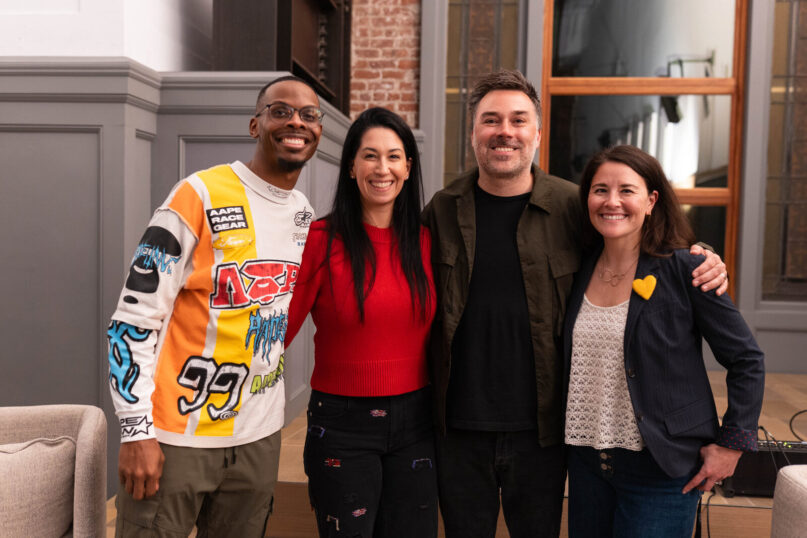
As for the Thiel connections: Stephens’ husband, Trae, is a partner at Founders Fund, Thiel’s venture capital firm. And at ACTS 17’s kick-off event in May 2024 — held at the San Francisco mansion of tech CEO Garry Tan — Thiel gave a “fireside chat” on “political theology.”
Since that launch event, ACTS 17 has hosted a handful of speakers on the intersections of faith, science, tech and culture, including Francis Collins, the former director of the National Institutes of Health and a well-known evangelical, and Pat Gelsinger, former Intel CEO and executive director of Gloo, the Christian AI start-up. Trae Stephens, who also co-founded the defense tech company Anduril, has also spoken on leadership, calling and AI.
At these events, start-up founders, venture capitalists, robotics engineers and other attendees mingle, appetizers in hand, while DJ Malcolm “CANVA$” Maholmes blasts remixed worship songs. In the weeks following each event, participants are invited to “Continuing the Conversation” gatherings at local coffee shops or to Sunday services at Epic Church.
In his final Antichrist lecture, Thiel praised the work of ACTS 17. “Whatever you’re doing here in San Francisco is more important than everything everybody’s doing in Christian work in the rest of the world, combined,” he said.
Stephens, for her part, is far more measured. “No one’s work for the Lord is more important than another,” she said. “I just regard us as doing our part.”
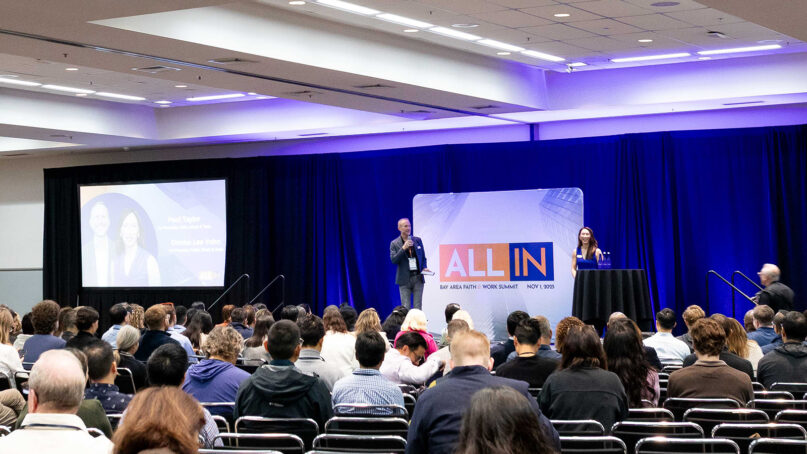
If ACTS 17 is the top of this Bay Area evangelical funnel, then Denise Yohn and Paul Taylor view their organization — Faith, Work, & Tech — as the narrow end, doing “the deep, slow work of discipleship,” as Yohn put it.
Inspired by the Center for Faith & Work, part of Redeemer Presbyterian Church in New York, FWT offers one-off events and multi-week formation programs to help participants integrate their Christian beliefs into their careers. So far, Yohn and Taylor have been overwhelmed by the response. On Nov. 1, they hosted their second Bay Area Faith & Work Summit, drawing hundreds of tech professionals and even a German documentary crew covering the Christ-ward shift in Silicon Valley.
While flattered by the international attention, Yohn was caught off-guard by questions she felt “conflated” their work with Trumpian politics. “What we’re doing here with Faith, Work, & Tech: it is in no way associated with what people would think of as the MAGA movement,” she said.
Yohn is also friends with Stephens, and they have discussed ways to collaborate. In 2026, FWT intends to host dinner discussions that might build on ACTS 17 speaker events. At least one, Yohn said, “will probably be on the End Times or the Antichrist.”
Whether all of this constitutes resurgence remains to be seen. As of 2024, according to the Pew Research Center, most Bay Area adults do not identify as Christian, and the number who do has dipped from 48% to 46% since 2014. Still, there are indicators of change: the American Bible Society recently found Bay Area young people are more likely to pick up a Bible than older generations. And nationally, Barna Group research suggests that among churchgoers, Gen Z and Millennials attend more often than older generations.
The ACTS 17 “Next Steps” webpage recommends seven San Francisco churches, all of them nondenominational and evangelical. One is Canvas Church, which Pastors Travis and Jena Clark started in 2013. After losing 70% of their members during the pandemic, Canvas has experienced tremendous growth since 2023, with numbers nearing pre-pandemic levels. Many of their congregants work in tech, Travis Clark said.
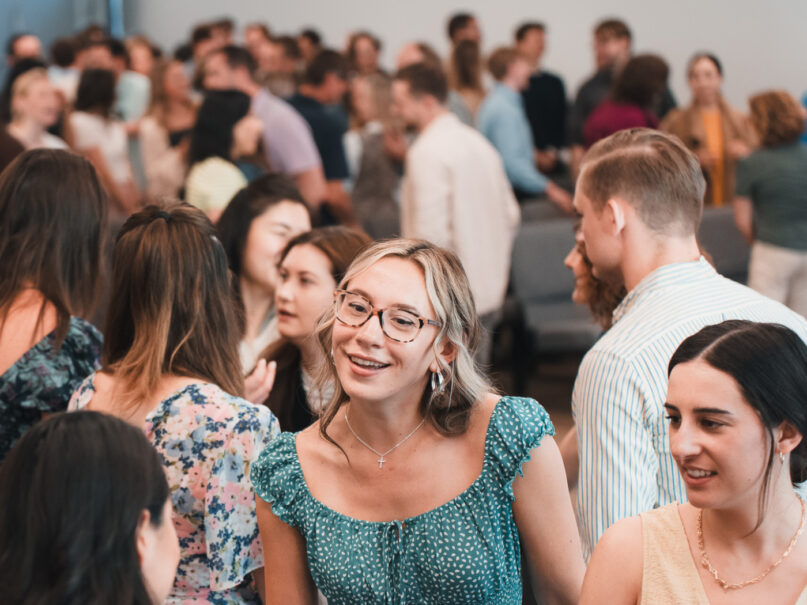
He points to political division and young people’s “hunger” for community and meaning as factors in the growth. “After Charlie Kirk was assassinated, you did see quite a few churches in the city — including ours — where attendance jumped,” Clark said. “In San Francisco, that’s not normal. So, I would say there’s definitely a shift.”
The Rev. Kevin Deal — a priest at a progressive, LGBTQ+ affirming Episcopal church in the city — sees opportunity and risk in this shift. For instance, a few of the congregations on the rise are, according to Deal, more conservative and “homophobic” than they let on. “Some churches have gotten good at making their initial presentation palatable to a very wide audience, and then, entering more deeply in, the restrictions are revealed,” he said.
Deal publicly criticized Thiel’s Antichrist lectures, calling them “antithetical” to the Gospel. While he believes ACTS 17 events can be an entry point for sincere faith, “so far, it seems centered on Peter Thiel and his kind of apocalyptic cynicism,” Deal said.
Stephens argued that critiques like Deal’s miss the larger frame around the lectures. “What you don’t know is, in the days and weeks before the event, leaders in our community were praying over the event: for protection, for hearts to be transformed, for Jesus to move,” she said.
While Onishi, the religion scholar, definitely sees motion, he argues “elitism” is a significant driver of this movement. Tech leaders see themselves as “part of a very small subset of people who will determine the fate of Western civilization,” Onishi said, citing Thiel’s critiques of diversity or Elon Musk’s embrace of “cultural Christianity.” For the tech class, he argued, evangelical Christianity is now offering a “transcendent” story to wrap around their “civilizationalism.”

“Does that signal revival in the Bay?” Onishi said. “I don’t think so. I think it signals revival in a certain social enclave of the Bay Area.”
Paul Taylor sees more at play. Alongside FWT, he joined the leadership team of Transforming the Bay with Christ, a nonprofit founded in 2013 by Gloo’s Pat Gelsinger that seeks to “catalyze a Gospel movement” through church networking. This new role has Taylor meeting with congregations throughout the region, and he said he’s encountering growth both inside and outside tech circles.
A trail runner, Taylor often finds himself on a hilltop with sweeping views of the South Bay. Lately, gazing out, he said he’s felt a sense of culmination, as if his longtime prayer — “God, pour out your Spirit on the Bay Area” — is being answered.
“Maybe not in the ways we anticipated,” he acknowledged. “But it does feel like that’s happening.”
This article was produced as part of the RNS/Interfaith America Religion Journalism Fellowship.