
Getting your audio player ready…
A simple turn of the wrist at the Metropolitan Museum of Art in February 2023 has unveiled a centuries-old mystery about ancient Roman craftsmen. Washington State University art history professor Hallie Meredith, who is also an accomplished glassblower, discovered abstract symbols carved into Roman glass cage cups that scholars had dismissed as mere decoration for more than two and a half centuries. Her maker’s eye saw what countless academics had overlooked – these were the signatures of ancient workshops, the brand logos of Late Antiquity.
“Because I am trained as a maker, I kept wanting to flip things over,” Meredith explained in the recent announcement by WSU. “When that happens, patterns appear that everyone else has literally photographed out of the frame.”
The breakthrough came while she examined a private collection of Roman glass cage cups, luxury vessels carved from single blocks of glass between 300 and 500 AD. These delicate masterpieces, known as diatretas, feature two concentric layers connected by fragile glass bridges, a feat of engineering that seems impossibly delicate even by modern standards.
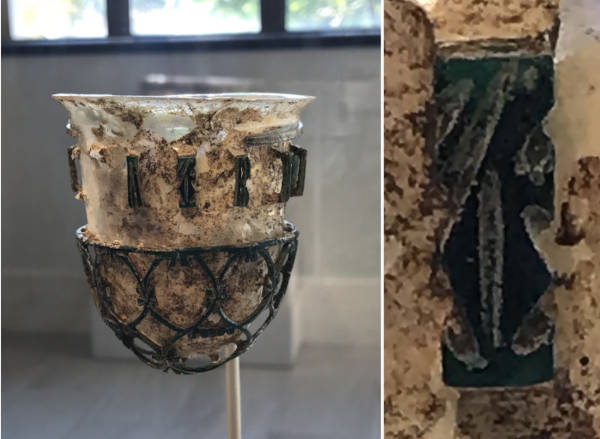
Roman glass openwork vessel with detail of its inscription: BIBE V[I]VAS I[..]A (Drink may you live). (Courtesy of Corning Museum of Glass/WSU)
Collaborative Craftsmanship in Roman Workshops
Meredith’s findings, published in two recent papers – one in April in the Journal of Glass Studies and another in October in World Archaeology – fundamentally challenge the romantic notion of solitary master craftsmen. The abstract symbols – diamonds, leaves, and crosses – carved alongside inscriptions wishing owners long life, appear across multiple vessels. By studying tool marks, inscriptions, and unfinished fragments, she demonstrated that these objects required coordinated teams of engravers, polishers, and apprentices working together, sometimes for months or even years on a single piece.
“They weren’t personal autographs,” Meredith noted. “They were the ancient equivalent of a brand.”
This revelation transforms our understanding of ancient Roman craftsmen and their working methods. Each cage cup began as a thick-walled blank, painstakingly carved into its final form, a lattice structure so light it appears to float. The abstract marks functioned like modern studio logos, identifying collective workshops rather than individual artists.
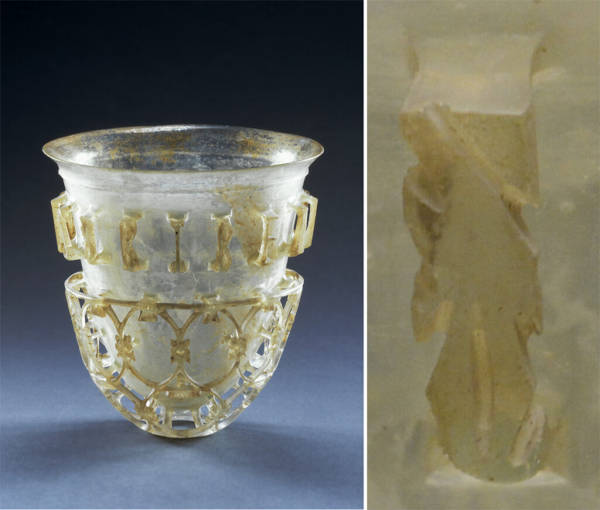
Glass openwork vessel excavated at Cologne dating to around 350–400 AD with an image of an inscription on the right. Inscription: BIBE MVLTIS ANNIS (Drink [may you live] for many years!) (photos courtesy of the State Collection of Antiquities and Glyptothek, Munich. (Photos by Christa Koppermann/WSU).
Restoring Visibility to Anonymous Artisans
Meredith’s background as a practicing glassblower gives her research a unique perspective. She understands the physical demands and technical precision required to shape molten glass—knowledge that informs her approach to studying ancient production methods. At Washington State University, she teaches “Experiencing Ancient Making,” a course where students 3D print versions of ancient artifacts, attempt hands-on making, and use an app she designed to virtually disassemble objects.
“The goal isn’t perfect replication,” she explained. “It’s empathy. Ancient craftworkers can be understood differently when their production processes are experienced.” This philosophy drives her broader mission to restore visibility to the anonymous artisans who shaped the ancient world. Her forthcoming monograph, The Roman Craftworkers of Late Antiquity: A Social History of Glass Production and Related Industries, currently in production with Cambridge University Press, explores this forgotten world in depth. Publication is expected in 2026 or 2027.
Digital Tools Reveal Ancient Secrets
Meredith’s next project bridges art history and data science. Working with WSU computer science students, she is building a searchable database to track non-standard writing – misspellings, mixed alphabets, and coded inscriptions – across thousands of portable objects. What earlier scholars dismissed as gibberish may actually be evidence of multilingual makers adapting scripts for new audiences, revealing the complexity of ancient workshops and trade networks.
“There’s been a static picture of people who do the work,” Meredith said. “We presume we understand them because we focus on elites. But when the evidence is assembled, far more is known about these craftworkers than previously thought.”
Her research ultimately challenges scholars to view ancient artifacts from a new angle. When light glances off a diatretum’s lattice, the glass reveals more than engineering marvel, it reflects the hands, skill, and imagination of the people who made it.
Top image: Glass openwork vessel from 300–350 AD with inscription and symbol. Inscription: ΠΙΕ ΖΗCΑΙC ΚΑΛWC ΑΕΙ (Drink, may you live well always!) Source: Courtesy of Hallie G. Meredith/WSU
By Gary Manners
References
Meredith, H. 2025. Roman carvings, inscriptions, and engraved symbols. World Archaeology. Available at: https://www.tandfonline.com/doi/full/10.1080/00438243.2025.2570270
Meredith, H. 2025. Makers’ marks on Roman glass cage cups. Journal of Glass Studies. Available at: https://journals.publishing.umich.edu/jgs/article/id/6943/
Washington State University. 2025. Hidden signatures of ancient Rome’s master craftsmen revealed. Available at: https://news.wsu.edu/press-release/2025/11/13/hidden-signatures-of-ancient-romes-master-craftsmen-revealed/