
Getting your audio player ready…
A massive 4,000-year-old Bronze Age coffin, carved from a single oak tree and discovered by chance at a Lincolnshire golf club, has arrived at Lincoln Museum, UK, where it will be displayed to the public for the first time in the new year. The 10-foot coffin, found during routine pond maintenance work in 2018, contains the remains of a high-status individual buried with extraordinary care. Along with it was found an exceptionally rare axe that has astonished archaeologists worldwide, reports the BBC.
When workers at Tetney Golf Club near Grimsby, northern England uncovered the ancient burial, they had inadvertently stumbled upon one of Britain’s most significant Bronze Age discoveries. The coffin, known as the “Tetney Coffin,” is one of only about 65 tree-trunk burials known from Bronze Age Britain. What makes this find particularly remarkable is not just its exceptional preservation, but the wealth of information it provides about Bronze Age burial practices and the ritualistic treatment of elite members of society four millennia ago.
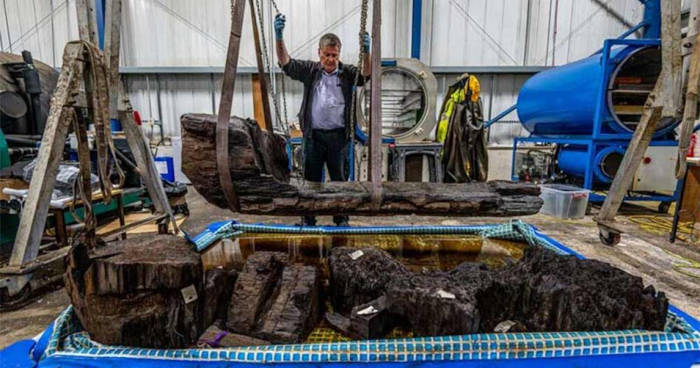
The “Tetney Golf Club” Bronze Age coffin, made from a massive split oak tree, being carefully lifted to a restoration workstation. (Charlotte Graham / York Archaeological Trust)
A Race Against Time
The moment the coffin was exposed to sunlight and air after four thousand years underground, preservation became an urgent priority. Fortunately, Dr. Hugh Wilmott, senior lecturer in European historical archaeology at the University of Sheffield, and his team of students happened to be working on a nearby excavation.
“Luckily when the burial was found, myself and a team of staff and students from the department of archaeology were working on a nearby research and training excavation,” Wilmott told The Guardian. “This was a brilliant learning experience for our students to see what can be achieved at short notice.”
Tim Allen from Historic England emphasized the urgency of the situation:
“This discovery takes us to the moment in time when a man was lain to rest in a fragile landscape of woods, salt and marsh.”
The team acted immediately to preserve the coffin before it could crumble, beginning what Allen described as a “painstaking” process. After initial stabilization, the coffin spent a year in cold storage before being moved to York Archaeological Trust for comprehensive conservation work, supported by a £110,000 grant from Historic England.
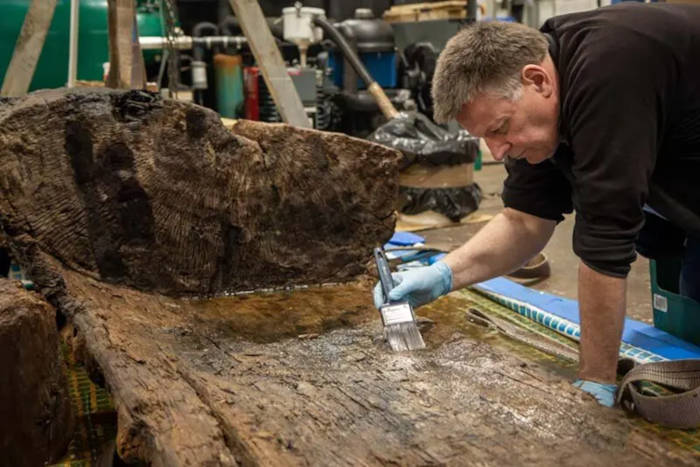
An up-close look at the Tetney Bronze Age coffin during restoration work. (Charlotte Graham / York Archaeological Trust)
Symbols of Status and Sacred Ritual
Inside the hollowed oak trunk, archaeologists discovered far more than just skeletal remains. The man, standing approximately 5’9″ tall – considerably above average for the Bronze Age – had been laid to rest on a carefully prepared bed of oak and yew branches. Analysis of plant and pollen remains revealed he wore a garland of flowers around his neck, while hazelnuts and other plants may have formed part of a food offering for his journey to the afterlife.
But perhaps most extraordinary was the axe buried alongside him. The finely crafted implement still retains its wooden handle intact – a survival so rare that only 12 such complete examples are known from Britain. Historic England confirmed the axe was “more a symbol of authority than a practical tool,” suggesting the deceased held significant social standing in his community. The preservation of organic materials – the wooden handle, plant remains, and even the oak coffin itself – is nothing short of astonishing.
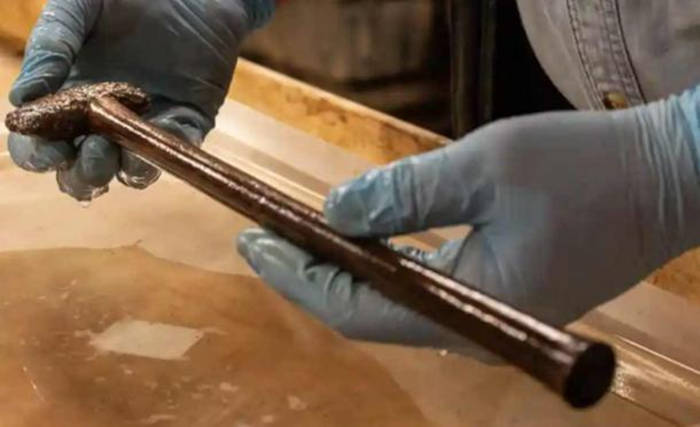
The ceremonial warrior’s axe found with the Bronze Age coffin in a pond at the Tetney Golf Club. This image shows the axe in the condition it was found before it was cleaned. (Charlotte Graham / York Archaeological Trust)
From Golf Course to Gallery
Mark Casswell, owner of Tetney Golf Club, expressed amazement at the discovery on his family’s land. “I’d never have imagined that there was a whole other world buried under the fields,” he said. “It’s amazing how well preserved the axe is with its handle still there like it was made yesterday. We’ll have a nice photograph of it up on the clubhouse wall.”
Ian Panter, head of conservation at York Archaeological Trust, explained the challenges ahead: “We hope to preserve the axe within 12 months but the coffin, due to its size, will take at least two years to fully treat.” The delicate move to Lincoln required detailed planning and expert handling, as Natalie Oliver, executive councillor for culture at Lincolnshire County Council, noted: “This is one of the most extraordinary objects—both in terms of its archaeological significance and its physical scale.”
The coffin will be unveiled when Lincoln Museum reopens following its current redevelopment. Oliver expressed the authority’s delight at finally sharing this “incredible piece of Lincolnshire’s heritage” with the public. The exhibition will bring together the coffin and the rare axe, offering visitors a window into Bronze Age society and the elaborate burial customs reserved for its most important members.
Top image: The Tetney Coffin after arrival at Lincoln Museum, where it will soon be displayed. Source: York Archaeological Trust/ BBC
By Gary Manners
References
BBC News. 2025. Bronze age “Tetney Coffin” arrives at Lincoln Museum. Available at: https://www.bbc.com/news/articles/cx278g1d768o
Guardian. 2021. Details of rare bronze age coffin found in golf course pond revealed. Available at: https://www.theguardian.com/science/2021/sep/10/rare-bronze-age-coffin-found-golf-course-pond-axe
Historic England. 2021. Rare Early Bronze Age Discovery On Lincolnshire Golf Course. Available at: https://historicengland.org.uk/whats-new/in-your-area/midlands/tetney-bronze-age-coffin/
University of Sheffield. 2021. Rare early Bronze Age log coffin discovered on Lincolnshire golf course. Available at: https://sheffield.ac.uk/news/rare-early-bronze-age-log-coffin-discovered-lincolnshire-golf-course
York Archaeological Trust. 2021. Bronze-Age Log Coffin Being Conserved by YAT. Available at: https://yorkarchaeology.co.uk/bronze-age-log-coffin-being-conserved-by-yat/